STM32 UART Part 5: Receive Unknown Length Using DMA
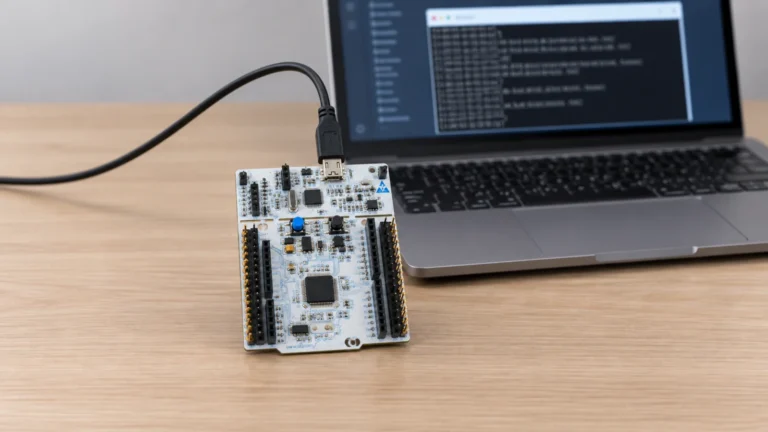
Using DMA in normal (non-circular) mode with the IDLE line interrupt turns UART reception into a smart, event-driven system. Instead of blindly filling buffers, the DMA captures bursts…


A working example uses STM32 HAL driver APIs, beyond an incidental HAL_Delay call.
147 articles · Page 6 of 15
Using DMA in normal (non-circular) mode with the IDLE line interrupt turns UART reception into a smart, event-driven system. Instead of blindly filling buffers, the DMA captures bursts…
This guide demonstrates how to interface a GLCD12864 display based on the ST7920 controller with an STM32 microcontroller using the U8G2 graphics library. We…
In this part of our UART guide series, we will explore how to receive data of unknown length using interrupts triggered on each incoming character.This approach allows…
In this part of the guide, the emulated I²C sensor will act as a data source, sending predefined or dynamically generated values back to…
In this part, we focus on receiving data using both polling and interrupt-driven methods. Polling continuously checks the UART status flags for incoming data,…
The SH1106 is a popular monochrome OLED display driver, commonly used in small screens ranging from 0.96″ to 1.3″, offering high contrast and low power consumption.…
PWM Input mode on STM32 timers is a powerful feature that allows the microcontroller to directly measure the characteristics of an incoming PWM signal,…
In this part, we will use the U8g2 library to interface the popular SSD1306 OLED display with STM32. This will demonstrate how to initialize the display…
In this part of the guide, the emulated I2C sensor will handle incoming configuration data sent by the master device. This allows the STM32…
This guide focuses on implementing ADC oversampling on STM32 to improve resolution and reduce noise in analog signal acquisition. It explains the oversampling principle, hardware configuration,…