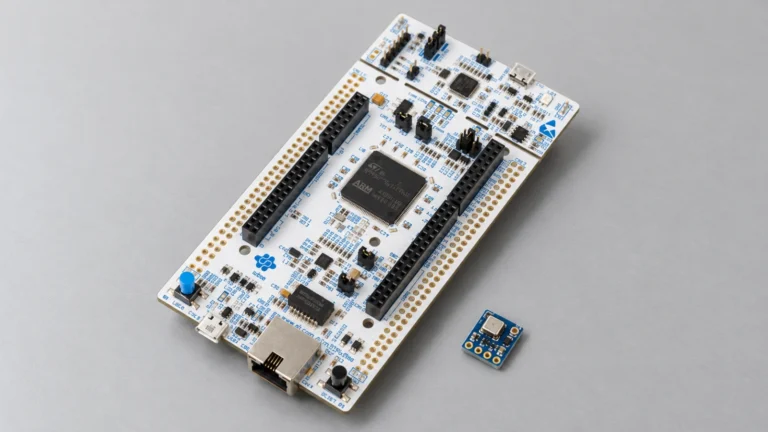
Interfacing BMP180 with STM32 Part 2 : Firmware Development
In Part 2, we dive into the core firmware development by establishing $I^2C$ communication to read the factory-calibrated coefficients and raw data from the BMP180 sensor.…


509 articles · Page 5 of 51
In Part 2, we dive into the core firmware development by establishing $I^2C$ communication to read the factory-calibrated coefficients and raw data from the BMP180 sensor.…
Break away from continuous polling loops by utilizing the STM32F4’s External Interrupt/Event Controller (EXTI) to capture asynchronous hardware events instantly. This guide demonstrates how to map…
By offloading time management to the SysTick timer interrupt, you can replace blocking delays with a non-blocking, interrupt-driven time base that keeps your CPU free…
In this sixth part of the guide, we configure the STM32 system to synchronize its internal time with an NTP server over the network.…
Mastering the BMP180 begins with establishing a robust communication bridge between the STM32 and your development environment. By prioritizing the configuration of UART and…
Transition from driving outputs to interpreting the physical world by configuring the STM32F4’s GPIO pins as digital inputs using Low Layer (LL) drivers. This…
In Part 6, we elevate our project by integrating the Light and Versatile Graphics Library (LVGL), transforming raw hardware drivers into a professional-grade graphical user…
Master the balance between hardware control and code efficiency by leveraging the STM32F4’s Low Layer (LL) drivers for direct register access. This introductory guide…
In Part 2, we shall develop the core firmware and driver logic required to translate time data into the TM1637’s custom serial protocol. This…
In Part 5, we transition from hardware configuration to data acquisition by implementing the logic required to extract precise X and Y coordinates from…