STM32 Timers Applications: External Trigger as Totalizer
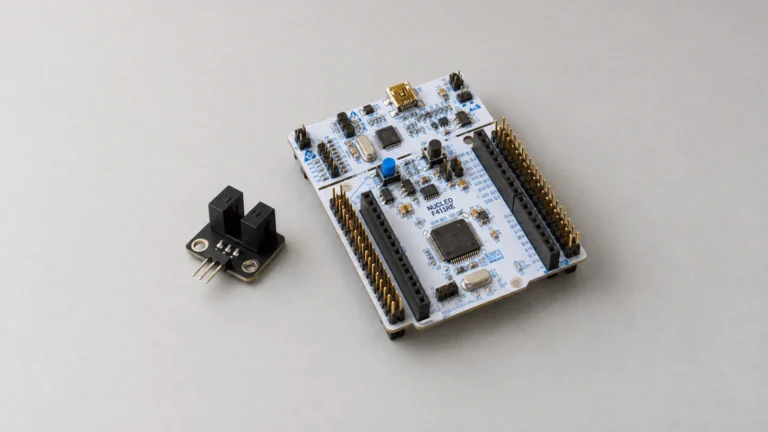
This application demonstrates how to configure an STM32 timer to use its External Trigger (ETR) input as the clock source, effectively turning the timer…


Hardware timer configuration or operation.
91 articles · Page 3 of 10
This application demonstrates how to configure an STM32 timer to use its External Trigger (ETR) input as the clock source, effectively turning the timer…
The External Trigger (ETR) mode in STM32 timers allows synchronization of timer operations with external events or signals, enabling precise timing control in real-time…
In this guide, we shall use DMA to capture the both, rising and falling edge of a signal. Once they have been captured, we…
Input Capture Mode in STM32 allows precise measurement of the time between signal edges by capturing timer counter values. It is commonly used for…
This guide demonstrates how to use an STM32 microcontroller to generate waveforms by updating the PWM duty cycle using a timer and DMA. By…
Output Compare mode is a powerful feature of STM32 timers that allows generating precise events when the timer counter reaches a predefined value. It…
PWM (Pulse-Width Modulation) is a fundamental feature of STM32F4 timers used to generate precise variable-duty cycle signals for controlling devices like motors, LEDs, and…
In this guide, we will explore how to use MicroPython on the STM32F411 Nucleo board for embedded development. We will specifically focus on configuring…
In this guide, we shall see how output compare mode works and develop a driver that will toggle the LED using hardware. In this…
Timers in STM32 microcontrollers are essential for generating precise delays, measuring time intervals, and controlling periodic events. This guide focuses on using STM32 timers…