Using Micropython for STM32F411: SPI Transmit
This guide demonstrates how to use SPI communication on an STM32F4 microcontroller with MicroPython. It shows how to transmit 5 bytes of data repeatedly…


505 articles · Page 14 of 51
This guide demonstrates how to use SPI communication on an STM32F4 microcontroller with MicroPython. It shows how to transmit 5 bytes of data repeatedly…
In this small and quick guide, we demonstrate how to perform I2C write operations using MicroPython to update register values on a connected device.…
In this third part of the STM32 ADC series, we explore how to use discontinuous mode to read multiple ADC channels efficiently. This mode…
I2C (Inter-Integrated Circuit) is a widely used communication protocol that allows microcontrollers to interface with various peripheral devices using just two wires. In this…
In this second part of the ADC series on STM32, we explore how to handle single-channel, single-conversion ADC using interrupts and DMA. To enhance…
This guide demonstrates how to use an STM32 microcontroller to generate waveforms by updating the PWM duty cycle using a timer and DMA. By…
Output Compare mode is a powerful feature of STM32 timers that allows generating precise events when the timer counter reaches a predefined value. It…
Analog-to-Digital Converters (ADC) on STM32 microcontrollers allow precise measurement of analog signals by converting them into digital values for processing. Understanding the different ADC…
The STM32H5 series includes a hardware random number generator (RNG) that provides true random values, essential for cryptographic and security applications. This guide walks…
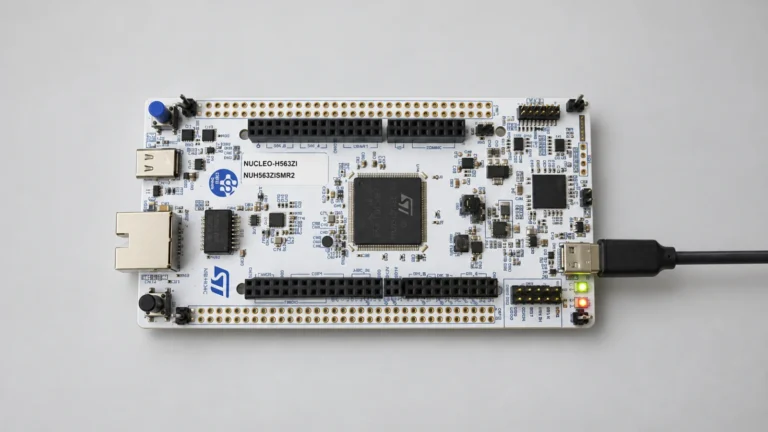
This guide demonstrates how to configure an external GPIO interrupt on the STM32H5 Nucleo-144 board. You’ll learn how to connect a push-button and trigger…